Ugrešić: The mythical story of Europa confirms richard dawkins’s meme theory, a theory of cultural genetics. Even an illiterate European, who has never heard of the myth of Europa, imagines Europe as a woman. she (Europe) likes us, or she doesn’t like us; or she betrayed us, or she will seduce us and make us new European slaves; she is a protector, or she is a whore. all in all, in our mindset Europe is heavily ‘gendered’. Interview by Grzegorz Jankowicz
The mythical story of Europa kidnapped by Zeus contains many elements that prove the myth is male-oriented. But two of them are most striking. Cadmus, Europa’s brother, is sent by their father to find his sister, and goes to the Oracle of Delphi to ask for advice. The Oracle tells him to forget Europa, find a cow, and follow her until she lies down in exhaustion. Cadmus is to found the city of Thebes on the spot where the cow stops. In the narrative about the foundation of Europe we have an abducted woman and a tormented animal. Not a very optimistic beginning, is it?
I agree-the beginning was not very optimistic. Nevertheless, it seems that Greek mythology offers many fairer deals-in terms of gender equality-than the Bible, for instance.
Commenting on the story, Denis de Rougemont stated that Cadmus, going after his sister, is looking for an infinite element. The kidnapped woman is presented as an entity exceeding all limits. We can interpret it in a positive way: the story proves the uniqueness and ubiquity of Europe. But when we look at it from a different perspective, it seems that the feminine element is simply placed outside the established borders. To create a city Cadmus has to leave his sister aside.
It was probably a wise decision: Cadmus was a linguist, the inventor of the alphabet or at least the Phoenician alphabet, and an intellectual. He gave up on his sister, and thus indirectly gave her the freedom to emancipate herself and live her own destiny. Let’s be honest, Europa faired extremely well. First of all, she was a beautiful, young Phoenician woman, sexually curious, and brave enough to experiment a bit. She had an exciting affair with a god in the form of a gorgeous white bull, a symbol of potent male sexuality. Europa caught a flight on his back (Zeus Airways) and landed in a new country to start a new life. She wisely accepted Zeus’s generous compensation: she got expensive jewelry, two mighty ‘bodyguards’ (Talos and Laelaps) and a great weapon, a javelin that never missed its target. She also received moral compensation in the form of a decent husband, Asterion, known only as Mr. Europa, the biological or assumed father of her three sons. Now, tell me, do you know any girl in the world who has faired better?
I don’t really follow the Italian media, but your interpretation of the myth sounds very familiar: the god, the girl, and a lot of fun. And if the society has certain doubts about the god’s misbehavior, it is the society’s problem… You don’t mean to legitimize the power of narcissistic masculinity, do you?
The beauty of myths lies in the possibility of numerous interpretations. I could have taken the usual perspective of Europa as a victim of rape, which is, of course, equally valid, but I prefer this one. It’s more humane.
Another quote from de Rougemont suggests that looking for Europa is an attempt to construct her. Given that Europa is an embodiment of femininity, how is the female figure constructed in the context of today’s idea of a united Europe? What are we looking for? And how are we constructing it?
The story of Europa confirms Richard Dawkins’s meme theory, the theory of cultural genetics. Even an illiterate European, who has never heard of the myth of Europa, imagines Europe as a woman. Europe is always a she. In many European languages Europe is a feminine noun, which is, incidentally, also the case with other continents. Accordingly, Europe is not only a location of desires, but also of disappointment. This emotional approach can, for instance, be nicely seen in the Croatian, Serbian and Bosnian media, starting from brutal Yugoslav divorce and wars, to the present day when Croatia and Serbia are lining up to get into the EU. The involvement of thd European political institutions, politicians and political forces in the Yugoslav wars (or their refusal to get involved), the Hague Tribunal, and the implementation of European standards-all of these things have provoked and continue to provoke very emotional reactions in both the media and everyday life. She (Europe) likes us, or she doesn’t like us; or she betrayed us, or she will seduce us and make us new European slaves; she is a protector, or she is a whore. We desire her, she rejected us; we are her children, and she treats us like a wicked stepmother; she is a sick, old hag, and so on and so forth. All in all, in the mindset of those excluded from the EU, Europe is heavily ‘gendered.’
Mythology is gossip about gods and their interactions with common people. Today we also have our ‘gods’ and we gossip about them. The majority of people like ‘gods’ whose lives resemble old mythological patterns. That’s why Nicolas Sarkozy and Carla Bruni are so popular in the media: it’s the old myth about a god’s power and a beautiful woman seduced by that power. The same goes for the unbreakable Silvio Berlusconi, and the same goes for stories about the European royal families and the general hype that surrounds them.
I am improvising here, of course, but if we take this mythological point of view, the same construction occurs around nations and states. The symbolic female figure is a ‘mother of the people,’ or ‘mother of the nation.’ Under that symbolic feminine umbrella the real power is in men’s hands.
But we have other European narrative matrices presenting the relationship between femininity, masculinity, and power in a different way.
There are other narratives, of course, especially in literature, visual art, film, popular culture, although not necessarily
European ones, of course. It seems though, that popular culture is quicker in bending and breaking gender stereotypes than traditional (high) culture. Many products of popular culture are popular exactly because they contain a gender empowering force. A typical figure of this kind is Lara Croft, for instance. In popular culture borders between sexes, genders and races, even between human and non-human species, are constantly expanded and questioned. The old myth about Europa is perfectly in tune with popular culture, especially her sexual encounter with a god.
There are also political narratives in the form of protests. It seems that European women wake up every ten years to once again get what they already had, but in the meantime managed to lose. Let’s limit ourselves to the issue of sex. Last year Italian women finally woke up and protested against Berlusconi, with no discernible result, unfortunately. This year women in France woke up and protested the sexism provoked by the Dominique Strauss-Kahn case.
There is a rich and complicated feminist narrative too. Feminism, once a wide mobilizing movement, has fragmented into thousands of narrow sub-fields, and lives on mainly in academic reservations. Activism has (for practical reasons) showed the same fragmentary tendency, structured by and within NGOs. The majority of women don’t belong to NGOs, and don’t live in the academic world. They are left alone to worry their own worries.
Then there are other narratives, those told by the statistics. European political structures are all male-dominated. The level of gender equality is far from acceptable, both in politics and in business. According to data I found on the Internet, women make up more than 27 percent of representatives in the lower house of parliament in only ten EU countries, with Sweden coming out on top with 45 percent. In the majority of the countries women make up less than 23 percent of all representatives, and in some countries less than ten percent. The European Parliament apparently scores a bit better. Women in both the public service and the private sector score much worse. Women chair only three percent companies in Europe, for instance. Europe suffers from huge gender inequality, in the labour market, in politics, in the distribution of money and power, in all domains. I can’t give you exact details, I am not an expert. But judging by the recent European buzzword-mobilization!- the picture of gender issues is pretty bleak. If we take into account the growing economic crisis, and the consequent growing nationalism, women will also be the first victims.
At the same time one can notice today an enormous proliferation of discourses on femininity.
According to some journalistic reports, in order to increase their popularity some European ultra-right, pro-Nazi groups are suddenly becoming ‘gender sensitive.’ Instead of unpleasant, over-masculine skinheads, their new icons are women. Women join such groups, only to be simultaneously used and abused in ‘beautifying’ the image of such groups.
The other cynical message comes from organized religion. Croatia, for instance, has managed to erase the gender equality, false or real, established by the socialist state of Yugoslavia, the Catholic Church having penetrated every pore of the society (and the same goes for Islam in Bosnia and the Orthodox Church in Serbia). There is even a danger of losing the legal right to abortion. During the Pope’s recent visit to Croatia, he made a speech appointing the Virgin Mary the country’s ‘spiritual navigator’ on its path to the EU. The Pope also appointed the Virgin Mary as a ‘spiritual supervisor’ for the whole of Europe. Who says that women don’t have any power? They do, if the Pope says so. Especially if these women are spirits, ghosts and symbols.
Let us go back to the myth of Europa. Europa should start taking better care of her daughters. She should use that miraculous javelin more ambitiously and seriously, and start aiming for the right targets, not the wrong ones. Otherwise, she will remain locked in her ancient image of a smart girl paid a generous fee for a one-night-stand with a mighty god.
ii
If one reads the myth carefully, one notices that Europa is one of the very few female characters in it. You said she was extremely lucky to have a romance with a god, to be a beautiful woman rewarded with a rich husband and sons who were supposed to become kings. But all the gifts are somehow related to men. Europa herself remains in the background. Her problem is a question of visibility. But how to make the difficult situation in which she functions visible? This is the first step to bring forth any social change. Let me give you an example from Poland. Some time ago we had a public discussion about the gender structure of political power. The idea was to have equal male and female representation in governmental institutions, which would be guaranteed by law. One can easily imagine the protests of the chauvinists. What was really striking were the protests of some women occupying high positions in various private and public institutions. Their argument was simple: if someone (in this case a woman) needs help in the form of a law, this means such a person cannot take care of her or his own problems. The law change would only serve as confirmation that women are kept in the background. So how to make this problem visible using cultural and institutional tools?
I am a freelance writer, an outsider, living in the space in-between nations, states, languages, and cultures, with no ethnic or religious identity. In other words, I live in a ‘grey zone,’ and all in all, I myself am very much ‘invisible.’ I don’t know anything about the practices of social organization, political or non-political. I’m really the last person to whom such questions should be addressed.
Recently, a young woman writer in Croatia was awarded a literary prize. She said: ‘I hope I didn’t get the prize just because I am a woman.’ Did you ever hear a man make such a statement? ‘I hope I didn’t get the prize just because I am a man’? The anecdote offers stark evidence that women are not used to equal treatment. All in all, not women, but men should be forced to confront the cold statistical facts that they live in an environment, locally and internationally, in which they are surrounded mostly by men: in politics, in culture, in structures of power, in the media, in the corporate world, everywhere. They should be forced to realize that the majority of them take such a social environment to be ‘natural.’ Therefore, men are the first who should be mentally reprogrammed to begin the fight for gender equality. It might be a difficult task, almost as difficult forcing a religious fanatic to accept the possibility that God is just disinformation. But only when the rules of gender equality are implanted everywhere, when they become a practice, the women’s turn will come. Then women will need to ask themselves a basic question: are they ready to bring about a real change in the society, offer some ‘new morality,’ or are they just going to perpetuate old patterns. But without achieving this actual power, women will never find out. And neither will men.
You mentioned the cynical message coming from organized religion… Religion has not supported the equality of women and men in a way that could create positive social effects. Do you see any possibility of changing this situation? Is it possible to think of (and to fight for) cultural, social, and political equality using religious discourses?
I am an atheist. In my opinion, an organized religion, numerous religious institutions are the forms of legalized manipulation of people, with shamelessly long and steady tradition. Organized religion should be in administrative terms taken as licensed business, a form of alternative collective psychotherapy. A special ‘religious tax department’ should thoroughly control the income of all religious institutions. Taxes collected from the ‘religious sector’ should be used for improvement of medical care, for instance, which in an ideal society should be free of charge for everyone. On the other hand, religion as a resistant and rich cultural text should be transferred into a history of humanity, into the history of ideas, history of political ideas, philosophy and literature.
At some point in the XVIII century Jean Jacques Rousseau paraphrased Saint Paul writing that there are no longer Frenchmen, Germans, Spaniards, or English, but only Europeans. Later this noble term was defined in different ways. Writers, philosophers, politicians-all of them tried to describe the essence of the European citizen. Could you try to answer the question: ‘What does it mean to be European women’?
It will be wonderful to surf in a border-free world. But in spite of his noble efforts poor Jean Jacques Rousseau is still treated as a French writer. The notion of European culture is used as a sort of cultural currency, a sort of spiritual Euro, as a language of diplomacy, and therefore it has been abused, at least in my opinion. The popular slogan ‘culture without borders’ doesn’t solve the problem. True, culture travels through Europe, but ordained with national flags and passports. Artists and writers travel and interact as national representatives. That’s why being a woman in today’s Europe means being a German woman, a Polish woman, and so on. Being a writer in today’s Europe means being an Austrian writer, a Polish writer, and so forth. It seems that there is no way to change this, because the new (other than national) ground failed to be built. I live in the Netherlands. I am a Dutch citizen. In the Netherlands I am labeled a Croatian writer. In Croatia I am labeled a Croatian writer living in the Netherlands. I myself do not care less: I am neither; I am a ‘writer of a duty free zone.’ So how can I act as a European writer when there is no unifying cultural platform, when all and everything is seen, taken, exchanged and consumed as a ‘national product’?
There are many questions to be answered. When Yugoslavia, for instance, fell apart, I’ve heard many intelligent people saying: ‘But Yugoslavia was anyway a sort of unnatural state construction, wasn’t it.’ Which state construct is natural? What does ‘natural’ mean? Is ‘European’ more natural than ‘Yugoslav’, and why? Will Croatia, as a future member of the EU, be more ‘natural’ within the EU then within former ‘unnatural’ Yugoslavia, and why?
Zygmunt Bauman understands Europe not as an unfinished project (which has to be created or realized here and there with old or new means and tools) but as an unfinished adventure (which can bring into life some unpredictable consequences). He writes that today we need more adventurers than ever before. Are you ‘a creator’ (in a sense of someone who realizes the project) or ‘an adventurer’? And what does it mean for your writing?
I don’t understand the difference, because being an authentic creator means being an adventurer. Creation and adventure, at least in literature and art, are almost synonyms. Europe is an unfinished project, which is good for now. Only totalitarian projects are ‘finished,’ petrified and predictable. Our modern times, as Zygmunt Bauman teaches us, are unpredictable and fearful. I have my fears too: too many people in today’s Europe are jobless, poor, frightened, depraved and worried about how they are going to feed their children and themselves. That’s why any relevant talk about today’s Europe should start from that fact.
Imagine you are about to rewrite the myth of Europa
changing its pattern of social relationships. What would your
version look like?
Instead of answering your question, I’ll tell you a story, which might be just a small a part of my possible answer. In the year 2000 I traveled through Europe by train, together with a hundred European writers. It was a unique journey. On our way we stopped in Brussels, and we got invited to the EU headquarters, to meet the EU cultural representatives. A person, a cultural representative of the EU, welcomed us on behalf of the EU cultural bureaucracy, pronounced a few words and disappeared. However, this was not the end of our formal visit. We were given pencils and a piece of paper, and were kindly asked to address a few 'wishes’ to the ‘mysterious’ cultural representatives of the EU. We did our ‘homework.’ Then the organizer collected our ‘wishes’ and put them in a box. Two or three state ments were randomly picked up from the box and read aloud. Statements were honest and constructive. In the administrative heart of Europe there was nobody to listen to those statements, except us. This episode was for many of us the most ironic moment of our wonderful European journey. It was also a sort of regression therapy; we traveled to Brussels to tell our wishes to the Wonderful Wizard of Oz. My answer to your question might be there (I imagine so), in the EU headquarters in Brussels, in some archive, in some dusty box, among hundreds of letters written by my European fellow-writers…
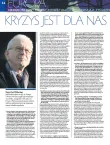
Dubravka Ugrešić (1949), croatian writer and essayist. she is the author of several novels, short story collections and essays. her books-“baba yaga laid an Egg," “nobody’s home," “The ministry of pain," “lend me your character," “Thank you for not reading," “The museum of unconditional surrender," “The culture of lies," “have a nice day," “in the jaws of life and other stories," “fording the stream of consciousness"-have been translated into many European languages and got several international literary awards. her latest book of essays “karaoke culture" will appear in English language later this year. dubravka ugrešić lives as a freelance writer. she is based in amsterdam.
„Tygodnik Powszechny” – jedyny polski tygodnik społeczno-kulturalny.
30 tys. Czytelniczek i Czytelników. Najlepsze Autorki i najlepsi Autorzy.
Wspólnota, która myśli samodzielnie.
Artykuł pochodzi z dodatku Europa: niedokończony projekt